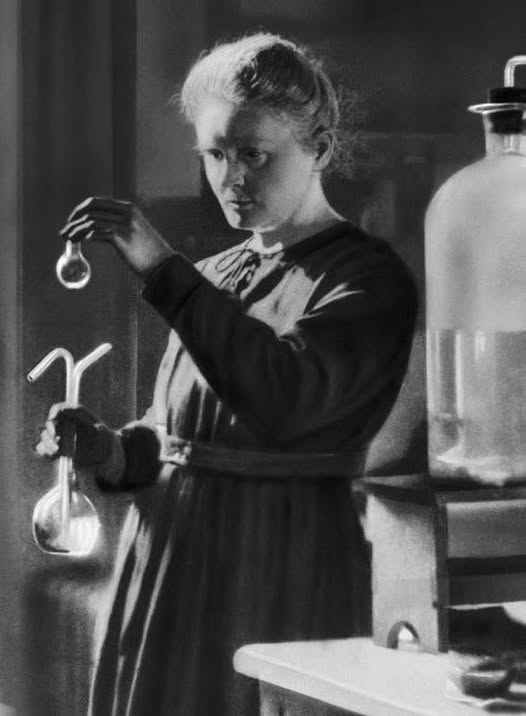
Maria Salomea Skłodowska was born in Warsaw on November 7, 1867. Poland did not exist as an independent country. Russia controlled Warsaw and suppressed Polish culture. Her father taught mathematics and physics. Her mother ran a boarding school for girls. Both parents valued education. Both died when Marie was young. Her mother died of tuberculosis when Marie was ten. Her father lost his teaching position for Polish nationalist sympathies.
Marie excelled in school but could not attend university. Russian authorities prohibited women from higher education. Secret "floating universities" operated in Warsaw, moving locations to avoid police. Marie attended these illegal classes. She learned chemistry, anatomy, and mathematics in private apartments. The risk was real. Discovery meant exile to Siberia.
Her sister Bronisława wanted to study medicine in Paris. Marie wanted to study physics. Neither had money. They made a pact: Marie would work as a governess to fund Bronisława's education. Then Bronisława would support Marie. This plan took six years. Marie worked in rural Poland from 1885 to 1891. She saved every coin she could.
She arrived in Paris in November 1891 at age 24. She enrolled at the Sorbonne. She lived in a garret with no heat. She ate bread and tea and little else. She fainted from hunger and cold during winter. But she could study. She ranked first in her physics degree (1893) and second in mathematics (1894). Her performance caught attention. The Polish Society of Sciences gave her a scholarship. A professor introduced her to Pierre Curie, who needed a lab space for a Polish physicist. They married in 1895. Their scientific partnership would change history.